
Restoration ecology via integrative eDNA approaches at the Salar de Punta Negra
eDGES v2 – Project 3
This project focuses on the Salar de Punta Negra, where a restoration plan is in place which will require monitoring over a decadal temporal period. Environmental DNA (eDNA) approaches are combined with routinary hydrogeological and biotic data to assess the ecological recovery of the Salar. The collection of eDNA samples involves the participation of local industry operators and consultants. By targeting the water column of the Salar, we seek a thorough ecosystem-level assessment of the ecological restauration of the lake through comparison with a range of other wetland ecosystems within the region. A multi-eDNA assay approach (targeting from bacteria to wading birds) is being employed to survey the biodiversity hosted by the Salar de Punta Negra and other wetlands across multiple seasons. Where possible, these molecular data are combined with conventional net sampling data (using macroinvertebrates as ecological indicators) to assess the validity of eDNA-based investigations at the salars. In addition, the data gathered through the project will also help explore the designing of STICI (Salar Taxon Independent Community Index) and refine current kits designed for saline/hypersaline freshwater environmental biomonitoring. For the testing of the applicability of STICI, we will be leveraging previous work of by Wilderlab NZ Ltd on the “taxon independent community index” (TICI) (Wilkinson et al., 2024), and also the technical aspects and lessons learned on from the eDGES sister project LiWA (Project Stream 7). The broader program, led by the eDGES team, involves BHP staff, associated workgroup representatives and local Chilean academics to participate in the sample collections, biomonitoring and data analysis to create meaningful connections to the restoration’s progress. The lessons learned in terms of ecosystem management have the potential to frame this study as a frontline project for effective collaboration between industry and academia.
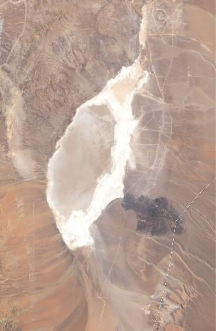
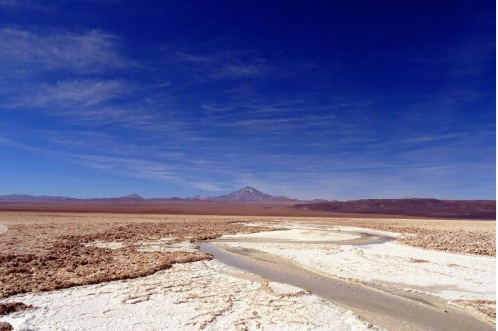
Figure 1: Aerial view of the Salar de Punta Negra (left) and photo from the Salar in Summer (right).
Overview of expected outputs and outcomes
- Publication of the cornerstone study tovalidatethe use of eDNA as a biomonitoring tool for metazoans at the Precordillera Chilean hypersaline lakes. Collaborative manuscript published in the journal Frontiers in Ecology and Evolution: https://doi.org/10.3389/fevo.2025.1504666.
- Sampling campaign at Salar de Punta Negra and Salar de Imilac carried out in April 2026 – 115 water samples collected across the two wetlands.
- eDNA workflow in progress, involving the following 6 assays: Bact16S (Bacteria); 18S V4 (protists); cpDNA rbcL (diatoms); COI (eukaryotes); 18S (eukaryotes), 12S (birds). Expected results in the second quarter of 2026.
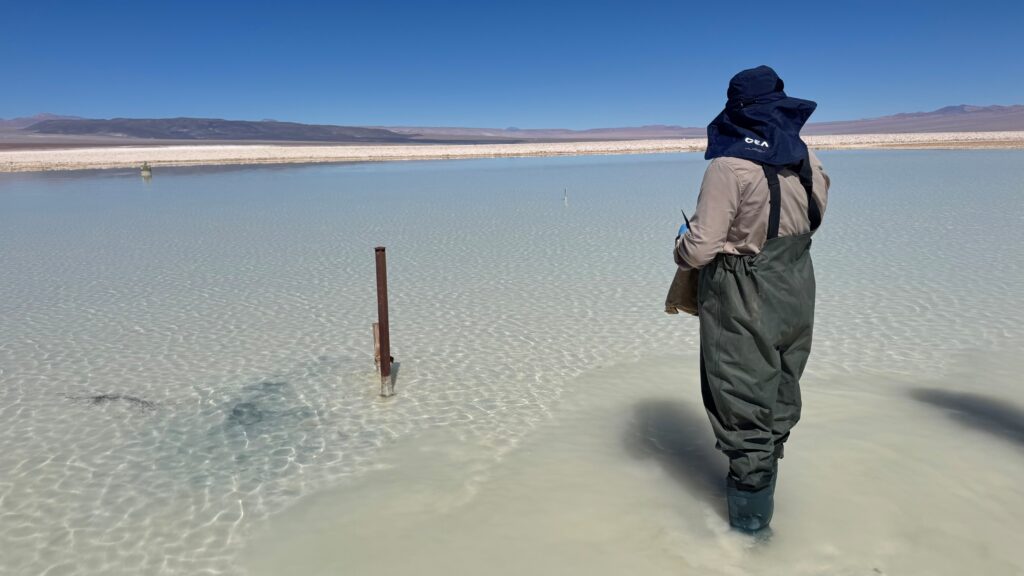
Figure 2: Collection of samples at Salar de Imilac.
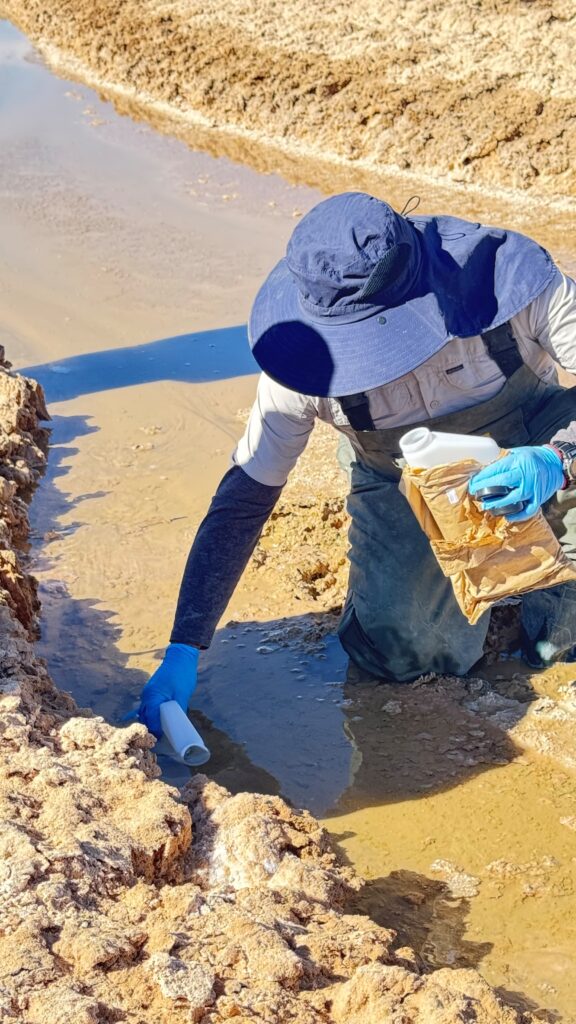
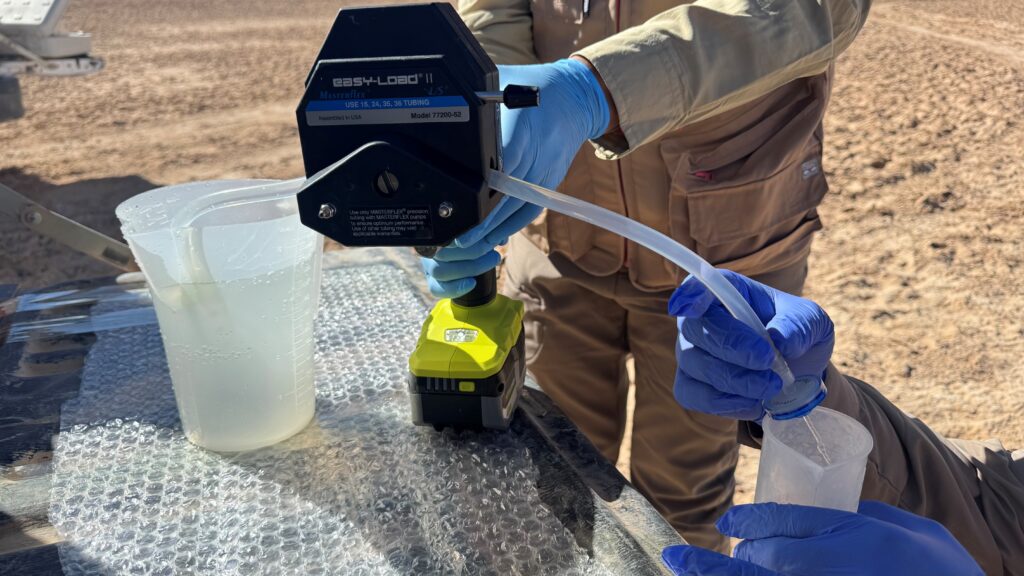
Figure 3: Sampling from a shallow water column at Salar de Punta Negra (left) and filtering water samples on site through the drill pump system (right).
- Publication of the additional study to validate the use of eDNA as a biomonitoring tool for microorganisms at the Precordillera Chilean hypersaline lakes. Submission of the manuscript expected by July 2026.