
Terrestrial ecosystem biomonitoring with eDNA across the tree of life: The Olympic Dam case study
eDGES v1 – Project 6
Landscape-scale conservation and restoration interventions can significantly improve ecosystem condition, but their success depends on the ability to measure ecological outcomes accurately and consistently. This project started addressing that need by developing and testing environmental DNA (eDNA) methodologies capable of capturing biodiversity signals across a wide range of terrestrial taxa. The project recognised that biological monitoring is essential not only to assess whether restoration targets have been met, but also to inform future land management actions and provide accountability to stakeholders.
In this project, we began to validate and implement DNA-based tools for monitoring terrestrial biodiversity, focusing on arid environments. This project began 8 months before the end of v1 with the intention of continuing in v2. As such, it is part of a broader effort to support large-scale conservation and restoration initiatives through the development of scalable, reliable, and accessible biodiversity monitoring frameworks.
The work responded to the challenges of conducting ecological monitoring in arid and remote regions. Traditional field methods in such environments are often time-consuming, resource-intensive, and logistically difficult. In contrast, eDNA offers a non-invasive alternative that can rapidly generate large volumes of biodiversity data. However, its application in terrestrial systems, especially dryland ecosystems, had remained underexplored, and concerns about data validity persisted.
To address these limitations, the project first focused on simplifying and refining eDNA sampling protocols to reduce reliance on specialised equipment, cold storage, or laboratory infrastructure. This made the methods more practical and deployable in the field, opening the door to wider participation from community stakeholders. The team then investigated the variability of biodiversity signals captured through various eDNA sampling methods across different terrestrial microhabitats. These insights informed the development of robust, repeatable monitoring protocols suited to arid landscapes.
Overview of outputs and outcomes
Sample collection and processing of vegetation swab optimization test is complete
Nine samples each of swabs and mini paint rollers were collected from Leda Reserve in Wellard (WA) and two metabarcoding assays targeting vertebrates and eukaryotes were applied (12S and 18S, respectively). Overall, there was no significant difference in ZOTU richness detected from each sample type. However, the mean richness and unique ZOTU identified for rollers was higher than swabs considering both assays. For these reasons, we decided to use rollers in the spatial study at Olympic Dam (Roxby Downs, SA). Only about a third of the 12S sequences (a vertebrate specific metabarcoding assay) were assigned taxonomy, indicating greater development of reference databases is required to assess vertebrate diversity.
de Oliveira, M.E., Nevill, P. & van der Heyde, M. Swab vs rollers: a comparison of methods to collect eDNA from vegetative surfaces. BMC Res Notes 19, 130 (2026). https://doi.org/10.1186/s13104-026-07701-0
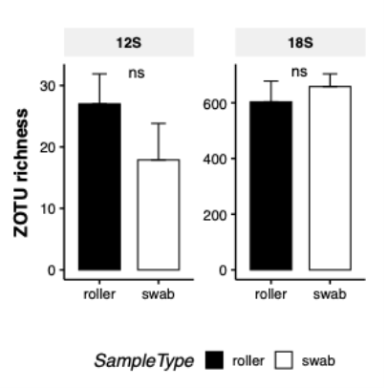
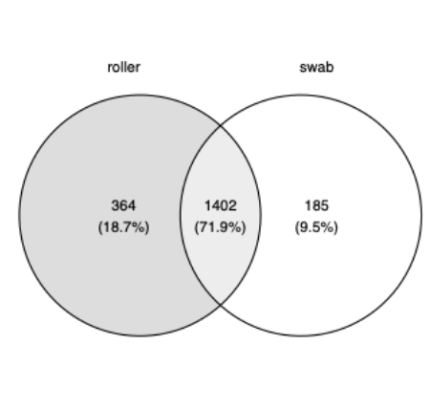
Figure 1: Results of vegetative swab trial comparing the eDNA collected by clinical swabs and mini paint rollers. Richness of ZOTUs – Zero radius Operational Taxonomic Units (left) and the Venn diagram of shared vs unique ZOTUs per sampling method and combining both assays (right).
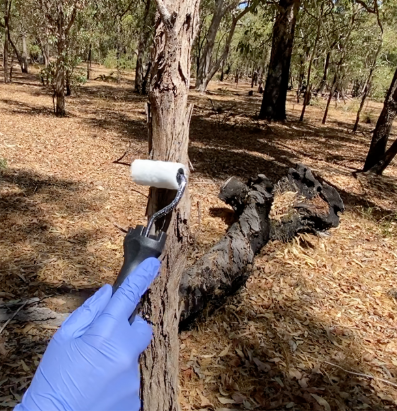
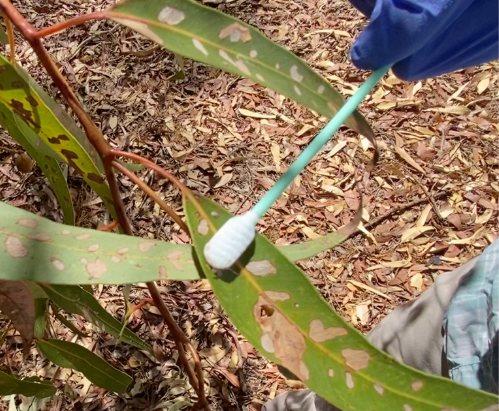
Figure 2: Images of the rollers (left) and the swabs (right) used in the vegetative swab trial.
Fieldwork at Olympic Dam for Spatial Study is complete – Samples from the Olympic Dam area were collected around Roxby Downs Village and adjacent bushland. Samples included air filters, roller swabs of vegetation and rocks, and soil samples. All samples have been processed and data analyses are complete. Results show that each sampling method captures different components of biodiversity, and this must be considered when designing an eDNA study. Both soil and rollers detected fine scale changes in community composition between the two land uses, highlighting the porential of these two substrates to provide local ecological answers, while airborne eDNA is better suited to detect broad-scale patterns of biodiversity.
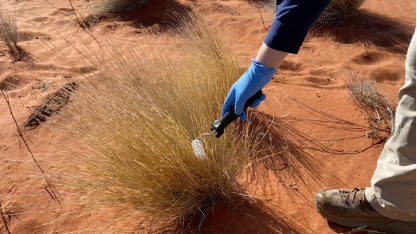
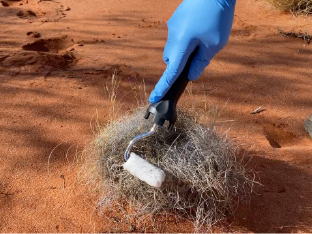
Figure 3: Roller and swab being used to collect eDNA deposited on vegetation surfaces in a bushland area at the Olympic Dam mine site.
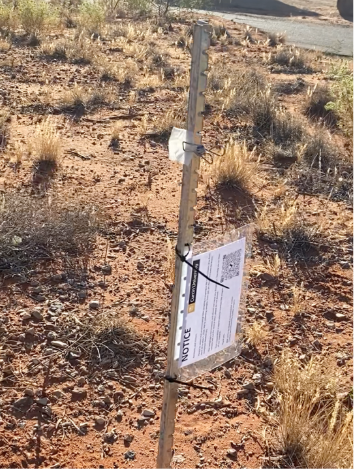
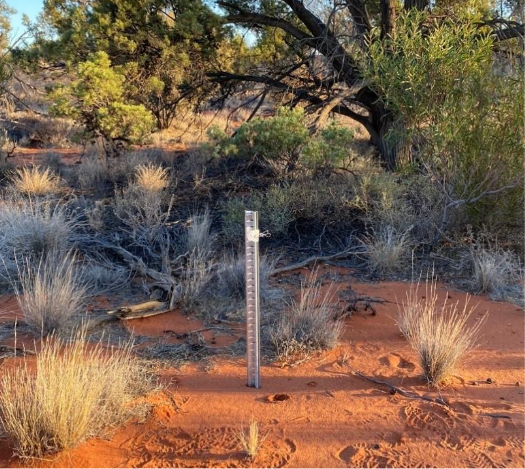
Figure 4: Passive sampling of airborne DNA, consisting of a small filter attached to a pole, showing the ease of installation and scalability of this method.
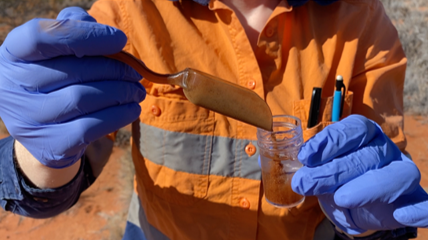
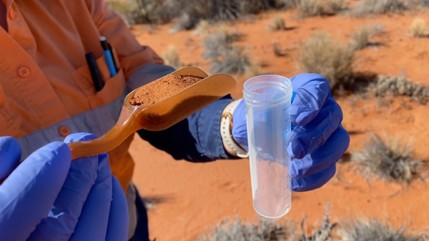
Figure 5: Soil samples collected and stored on ice (left) and in preservation buffer (right).
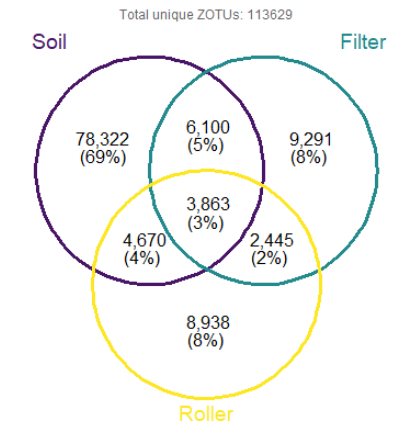
Figure 6: Venn diagram showing the unique and shared Zero-radius Taxonomic Units (ZOTUs) detect with each method across both Roxby Downs Village and neighbouring bushland.
Fieldwork for air DNA sampling comparison is complete – An honours level project comparing fixed short term, fixed long term and mobile air DNA sampling approaches for terrestrial vertebrate detection is complete. Over 256 km of transects were driven and 160 samples collected. All three methods used for sampling airDNA successfully detected vertebrate taxa. We have, therefore, demonstrated that sampling using a moving vehicle is feasible and can be as effective as other passive airDNA sampling methods. This study further validates the viability of collecting airDNA as a method of detecting vertebrate species for use in biomonitoring studies and the method can be applied to other types of mobile sampling, such as drone-based sampling. From our observations we recommend that mobile sampling should take place over multiple days, use multiple transects, and collect multiple samples per transect. Additionally, stringent contamination controls (gloves, mask etc.) should be employed to limit the influence of human DNA on vertebrate detections. We conclude that the mobile air sampler presents a practical and effective tool for airborne eDNA collection, particularly in scenarios where sampling time is limited and when detecting all species at a location is not essential, and may be of particular benefit for rapidly sampling large areas to get a “snapshot” of biodiversity. Further studies are required to examine the effectiveness of car-mounted airDNA sampling for other taxa like invertebrates, plants and fungi. A manuscript titled “eDNA on the go: A direct comparison of fixed and vehicle mounted airborne eDNA sampling methods for terrestrial vertebrate species detection” is in review.
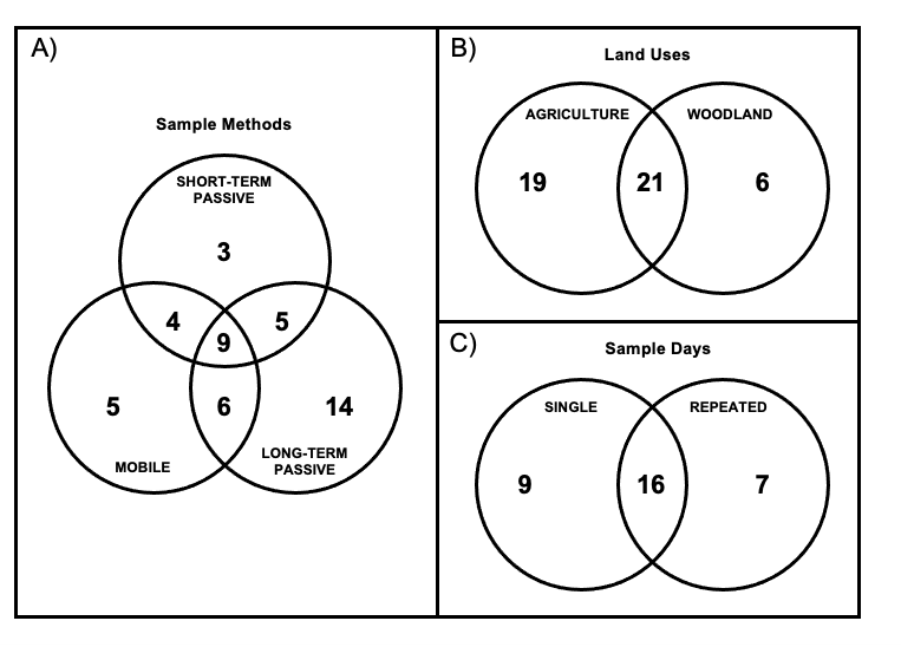
Figure 7: Venn diagrams showing the relationship between species detections using A) short-term passive, long-term passive and mobile sampling methods, B) two different land uses (agricultural and woodland) and C) sample single and repeated sampling efforts.
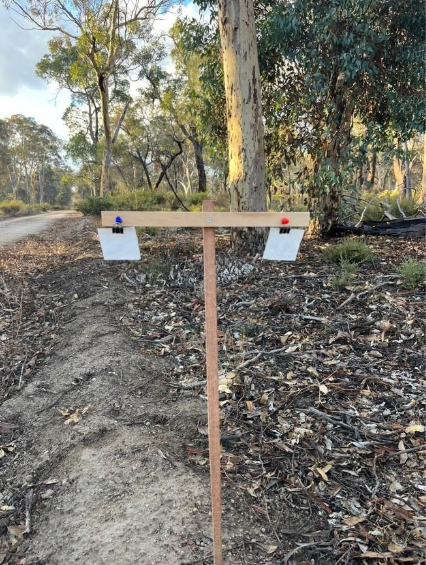
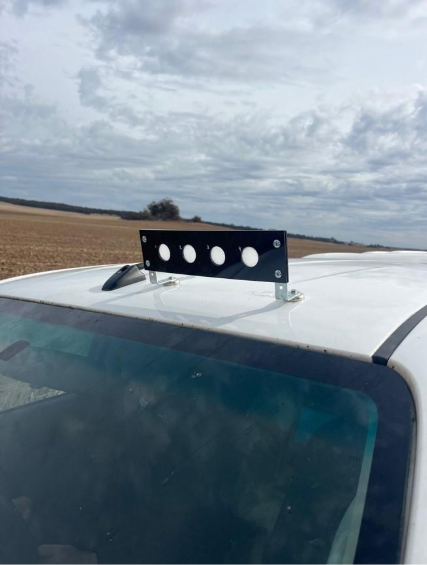
Figure 8: Air DNA sample collection fixed (left) and mobile (right).