
Detecting invasive marine species
eDGES v2 – Project 4
Invasive marine species (IMS) are a major driver of the global decline of marine ecosystem health. The establishment of IMS on marine infrastructure can result in negative environmental, social and economic consequences for affected regions. Previous work on IMS funded through eDGES achieved the development of a new metabarcoding multiplex assay that can be used to detect potential high risk IMS molluscs and crustaceans. We will build upon the previous research in this new project. Molecular methods for detecting IMS using environmental DNA (eDNA) can offer decreased cost, improved efficiency, sensitivity, and accuracy compared to traditional visual surveillance. However, the quality and type of information that eDNA analyses can provide is constrained by the genetic databases and sampling methods. Furthermore, the processing of eDNA samples is predominantly lab-based which can slow detections by the time samples are transported to a laboratory, processed and reported upon. There is a requirement for a field-deployable “point-of-need” identification for high-risk species where quick decisions are essential.
This project consists of four work packages, the first package Improving reference sequence databases will continue the work started in eDGES version one. Working with taxonomic experts we hope to resolve the taxonomic identifications of taxa of interest using genetic data, in particular the Saccostrea oysters and Brachidontes mussels. Packages two and three, will be the development and validation of new molecular tools that will be of benefit to Australian biosecurity regulators. The final package will use LiWA data to map invasive aquatic species (IAS) in some of the regions that the taxonomy-free approach will target, allowing interactions between IAS and overall ecosystem health to be measured.
Resolving taxonomic identifications of Saccostrea and Brachidontes mussels
Oysters are widespread in tropical oceans worldwide where they are both ecosystem engineers and commercially important aquaculture species. Some species are also significant IMS, including the Pacific oyster Magallana gigas. The species supports a thriving aquaculture industry in southeastern Australia but is also listed as a serious IMS pest. M. gigas has been recorded in the scientific literature from Singapore and Thailand. With the Pilbara construction boom of the 2010s there was considerable concern that construction vessels arriving from the two countries could distribute the species to WA. In eDGES v1 we surveyed key Pilbara localities and demonstrated that the species has not been introduced to the Pilbara. We then used modern DNA techniques to demonstrate the Singapore and Thai identifications of M. gigas were based on outdated taxonomy. M. gigas is not present in the northern Gulf of Thailand or in Singapore. Both countries have populations of two related species, M. bilineata and M. belcheri.
The other widespread intertidal genus, Saccostrea, is a taxonomic nightmare and our research for eDGES version 2 has turned to this genus. A 1985 analysis of the group concluded there is a single widespread Indo-Pacific species, S. cuccullata, that also occurs in the South Atlantic Ocean. However, recent genetic work on Saccostrea has demonstrated that there are several species that can be distinguished genetically but are not readily separated based on shell characters.
S. cuccullata was described from Ascension Island in the South Atlantic Ocean. Working with Ascension Island staff and our colleagues at the National University of Singapore we were able to obtain specimens of S. cuccullata from the type locality. DNA sequences demonstrated that the true S. cuccullata is restricted to the South Atlantic, and possibly southern Africa, but does not occur in the Indo-West Pacific. All identifications of S. cuccullata from the Indo-West Pacific, including Western Australia, are wrong. This work has recently been accepted for publication:
Tan SK, Wells FE, Tan KS, Lukehurst S, Morgan M & Fotedar S. (2025). Identity of the enigmatic oyster Saccostrea cuccullata (Bivalvia: Ostreidae). Journal of Molluscan Studies 91: eyaf007. https://doi.org/10.1093/mollus/eyaf007.
Another Saccostrea occurring in Western Australia is S. scyphophilla which was described from Bernier Island in Shark Bay. A number of authors have considered Saccostrea mordax from Fiji to be the same species. Oyster specimens collected during Carnarvon and Exmouth field work have been used in a redescription of Saccostrea scyphophilla. We have also been able to source topotype material of S. mordax from Fiji, with the help of Dr Chinthaka Hewavitharane (The Pacific Community) and Jasha Dehm (The University of the South Pacific). DNA extractions and PCRs for the 16S gene regions have been completed for all specimens. Our work has shown that there are in fact two separate species that overlap in some parts of the western Pacific. A manuscript reporting our results has been submitted for publication.
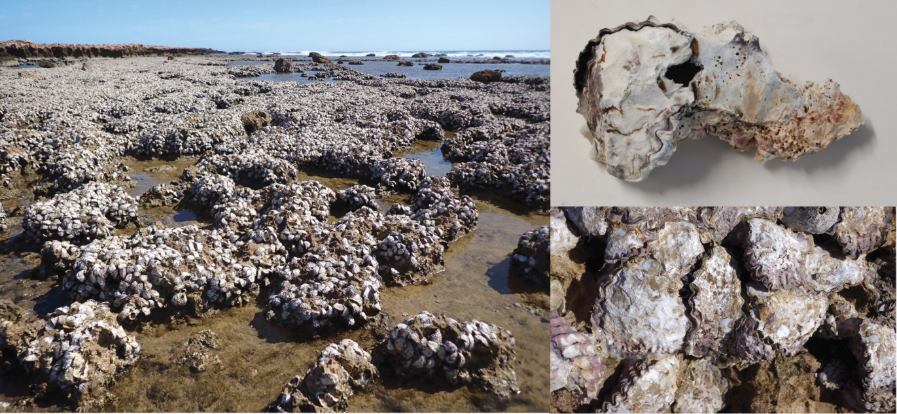
Figure 1: Oyster Bed at Point Quobba, Carnarvon WA. Saccostrea scyphophilla was described from Shark Bay, Western Australia. We are redescribing the species and examining its relationship with S. mordax from Fiji.
In eDGES1 we worked with a group of international scientists led by Dr Tan Koh Siang of the National University of Singapore on the taxonomy of eight species of the Brachidontes variabilis group of mussels. A paper was published on the results. We are now extending the study to examine the species of Brachidontes in Australia and are working with scientists from the major state museums.
The 2023 survey of oysters in the genera Magallana and Saccostrea in the northern Gulf of Thailand will be repeated on the Andaman coast of Thailand in November 2025.