
eDNA for subterranean fauna detection and conservation
eDGES v1- Project 2
Hidden Heroes: The Underground Ecosystem Engineers You’ve Never Heard Of
Deep beneath our feet, an army of microscopic invertebrates (Figure 1) are working around the clock to keep our groundwater clean and healthy. These subterranean organisms live their entire lives in the dark, water-filled spaces between rocks and sediments, yet they’re preforming essential services that directly impact the quality of water we, as humans, depend on. From tiny copepods to specialized beetles, these underground residents are nature’s own water treatment plant – decomposing organic matter, filtering out contaminants, and maintaining the delicate chemical balance of aquifers systems. We as scientists are discovering that these ‘ecosystem engineers’ don’t just survive in one of Earth’s most extreme environments; they’re actively shaping it, moving sediments, cycling nutrients, and creating the biological processes that keep groundwater systems functioning. Without these microscopic workers, the vast underground reservoirs that supply billions of people with fresh water would be far less stable and clean.
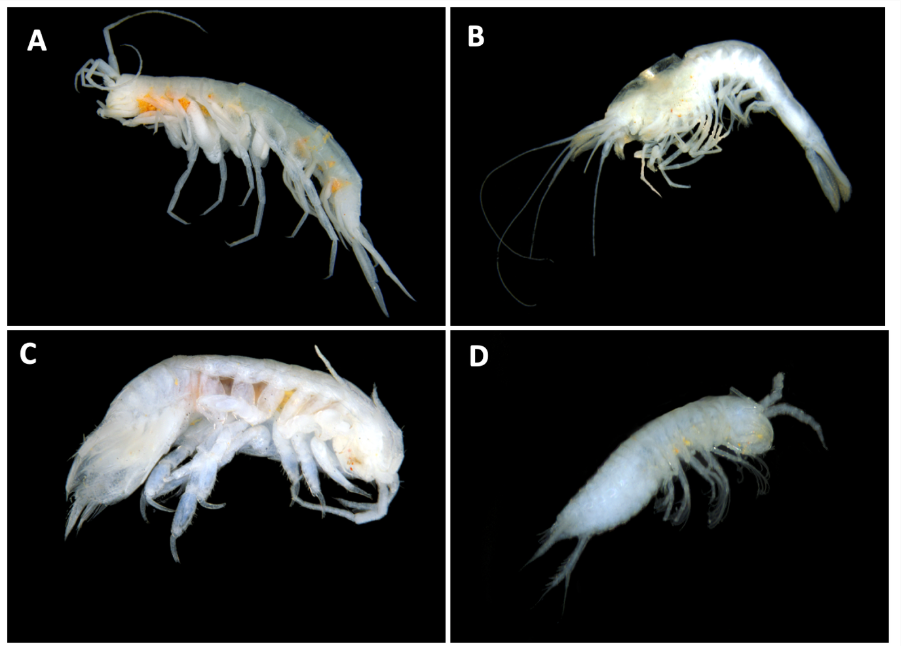
Figure 1: High resolution microscopic images of stygofauna; (A) Amphipod; (B) Decapod; (C) Isopod; and (D) Parabathynella.
Nature’s Underground Canaries: The Tiny Guardians of Our Hidden Water Reserves
These remarkable creatures, found nowhere else on Earth, have evolved over millions of years to thrive in the isolated world of underground aquifers (Figure 2) and their very existence has become a crucial indicator of whether our hidden water supplies are healthy or in danger. Like the canaries once used in coal mines, these specialised animals are so perfectly adapted to their specific underground homes that even small changes in water quality or environmental conditions can disrupt the ecosystem services they provide.
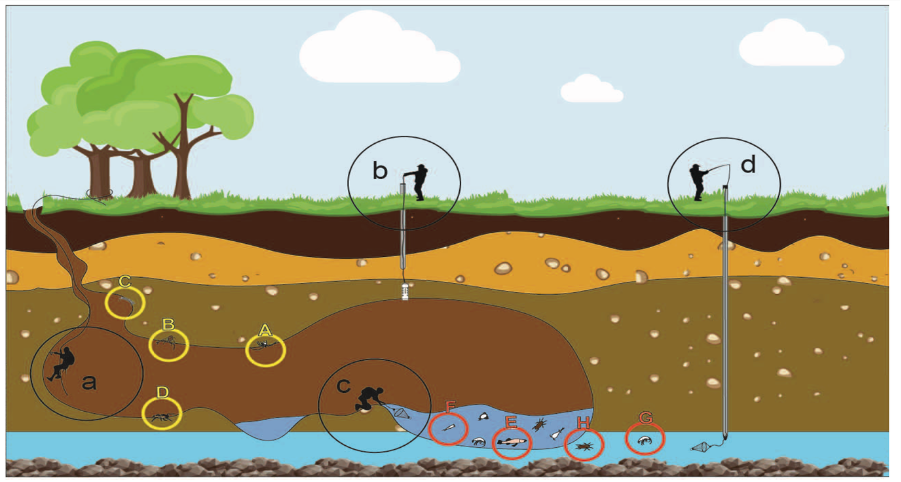
Figure 2: Published in Saccò et al., (2022) showing the main sampling techniques for subterranean fauna in underground ecosystems.
This project is merging genomics with eDNA to develop a novel methodological framework for discovering, describing and monitoring subterranean biodiversity in groundwater ecosystems. The technical challenges of shotgun sequencing microscopic organisms has now been achieved and the establishment of a mitochondrial genome database provides enhanced taxonomic resolution which is particularly valuable when dealing with cryptic species complexes or recently diverged taxa. Rather than relying on a single gene region that may be poorly conserved or difficult to amplify in certain taxonomic groups. This project is ‘moving beyond the barcode’ (Figure 3) to provide more robust phylogenetic context for species identification and eDNA assay design and validation.
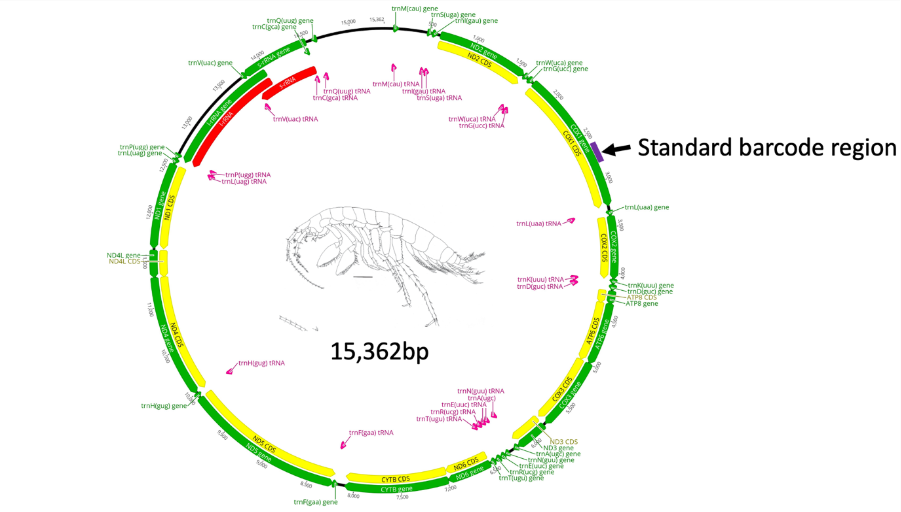
Figure 3: Complete 15,362 base pair (bp) mitochondrial genome of Amphipoda Chydaekata acuminata. The purple bar (top right) shows the standard barcode region in contrast to the complete mitochondrial genome.
Australia’s Rarest Residents: The Three Fish That Live in Eternal Darkness
Amongst the many thousands microscopic invertebrates inhabiting Australia’s groundwater systems, only three vertebrate species have mastered the ultimate survival challenge – living their entire lives in the dark underworld. Hidden beneath Western Australia’s rugged landscape, two species of blind fish (Figure 4) and one blind eel (which is actually a fish!) (Figure 5) represent some of the continents’ most exclusive residents, found nowhere else on Earth and nowhere else above ground. These evolutionary marvels have traded their eyes for enhance sensory abilities, navigating the darkness of subterranean waterways that most life forms could never survive in. These three fish species are amongst Australia’s most remarkable evolutionary achievement – living proof that life can adapt to even the most extreme environments, yet so rare and specialised that they exist in just a handful of underground systems across the continent’s northwest, making them infinitely more exclusive than any terrestrial wildlife Australia is famous for.
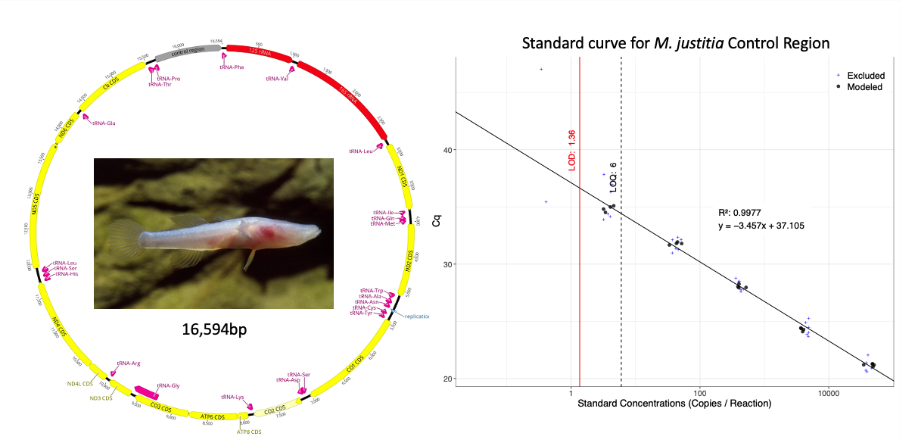
Figure 4: (Left) The mitochondrial genome of Milyeringa veritas (16,594 base pairs). (Right) Species specific eDNA assay validation targeting the control region for Milyeringa justitia. The limit of quantification (LOQ) shows six copies of DNA is the lowest concentration that can be reliably detected in an eDNA sample.
eDGES Project 2: eDNA for subterranean fauna detection and conservation has provided a team of scientists the ability to unlock the genetic secrets of Australia’s hidden underground world and the following provides a snapshot of the work that has been completed and currently under analyses:
- Sixty-seven complete or near complete mitochondrial genomes were successfully sequenced from spring animals that live in the Great Artesian Basin of South Australia.
- Sixty-seven complete or near complete mitochondrial genomes were also successfully sequenced from subterranean fauna that inhabit Ethel Gorge in Western Australia.
- Two blind cave fish mitochondrial genomes Milyeringa veritas (Cape Range) and Milyeringa justitia (Barrow Island) were successfully sequenced for eDNA marker development.
- A new eDNA assay for detection of blind cave fish has now been validated and shows high sensitivity.
- Fifty-five aquifer eDNA samples and 125 spring water eDNA samples from the Great Artesian Basin have been analysed and preliminary results show springs contain a higher diversity of organisms than aquifers.
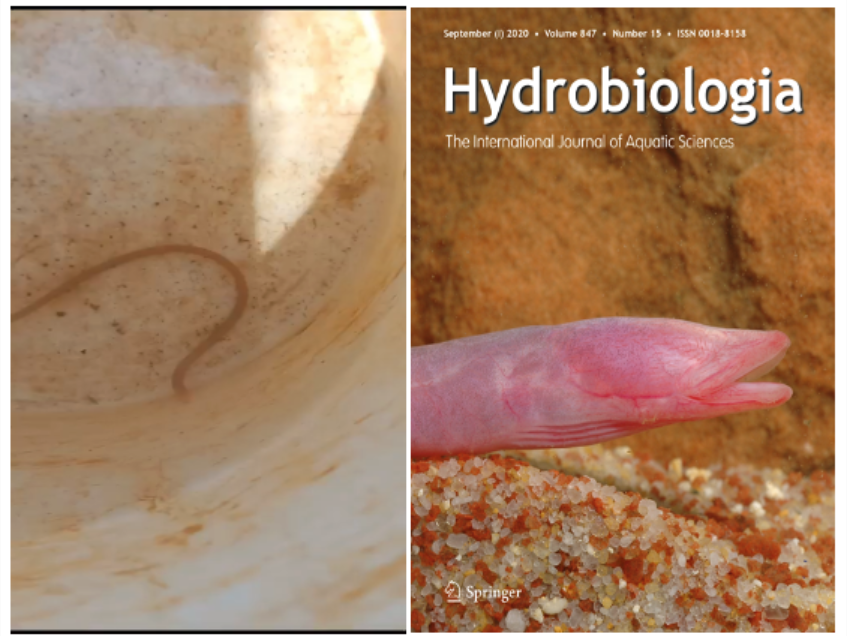
Figure 5: (Left) Video image of a blind cave eel incidentally caught during a stygofauna survey. Video provided by Syngeon Rodman, Biologic Environmental Services. (Right) Image of blind cave eel on the journal cover of Hydrobiologia (see article White et al., (2020)).
Papers now published:
Saccò et al., (2025) Advancing subterranean conservation through Global Research on eDNA in Groundwaters (GReG). Subterranean Biology, vol. 53:31-40. doi: 10.3897/subtbiol.53.165710.
Van der Heyde et al., (in review) Validating COI eDNA metabarcoding primers for detection of subterranean fauna.
Guzik et al., (2024) Towards a global reference library for subterranean fauna. bioRxiv preprint https://doi.org/10.1101/2024.09.20.613981.
Guzik et al., (2024) What are the best practices for curating eDNA custom barcode reference libraries? A case study using Australian subterranean fauna. bioRxivpreprint https://doi.org/10.1101/2024.09.18.611555.
Saccò et al., (2024) Groundwater is a hidden global keystone ecosystem. Global Change Biology, vol. 30(1).
Perina et al., (2024) An integrated study of Atopobathynella (Parabathynellidae, Bathynellacea) species reveals restricted distributions in a complex hydrogeological setting: two new species from the Pilbara. Contributions to Zoology, vol. 1.
Van der Heyde et al., (2023) Taking eDNA underground: Factors affecting eDNA detection of subterranean fauna in groundwater. Molecular Ecology Resources, vol 23(6).
Perina et al., (2023) Two new species of Atopobathynella (Parabathynellidae,Bathynellacea) from the Pilbara region, Australia. Systematics and Biodiversity, vol. 21(1).
Beasley-Hall et al., (2023) Time capsules of biodiversity: Future research directions for groundwater-dependent ecosystems of the Great Artesian Basin. Frontiers in Environmental Science, vol. 10.
Saccò et al., (2022) eDNA in subterranean ecosystems: Applications, technical aspects, and future prospects. Science of the Total Environment, vol. 820.