
Living waters of Western Australia (LiWA)
eDGES v2 – Project 7
Wetlands are vital ecosystems that support a rich biodiversity and provide several ecosystem services essential for ecosystem and human health, including cycling nutrients, filtering contaminants, and controlling water quality. However, wetlands are globally under threat due to mounting anthropogenic pressures, including in Western Australia (WA) which has many hydro-geologically, taxonomically, and functionally diverse wetland ecosystems. The importance and fragility of these environments is often undervalued by the public and even at a scientific level, knowledge on their biodiversity is insufficient. To this end, in this project are attempting to improve our understanding of the current and historical “health” of wetlands and to educate and inspire the broader community to conserve wetlands in Western Australia. A key contribution of this project will be the development of the novel AqWATIC “health” index derived from eDNA data which has the potential to serve as the basis of ongoing biomonitoring in WA wetlands.
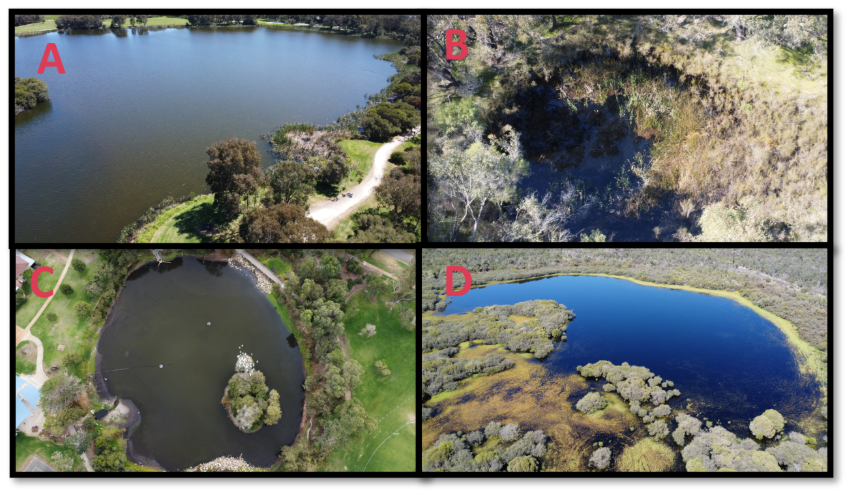
Figure 1: Examples of some of the types of wetlands sampled in 2024. Two sites (A) Herdsman Lake and (C) Marmion Reserve were identified as in “poor” health while (B) Quenda Swamp and (C) Nambeelup were identified as in comparatively better condition.
Overview of outputs and outcomes
We have generated a very large but still preliminary dataset of the biodiversity and water quality of 65 wetlands in south-western Australia. The results of the AqWATIC index to date have demonstrated promising results for its potential use to serve as a reproduceable and effective tool for the environmental management of wetlands. To this end, a significant effort has been made to communicate these preliminary results to the relevant staff of 10 different environmental management organisations to seek feedback and ensure that any tool produced is fit and practical for the needs of the industry it may be applied in. Further, a data sharing agreement with DBCA has been implemented to ensure two-way collaboration and the sharing of relevant information between the LiWA project and DBCA’s management objectives. We also held a community workshop on the various uses of eDNA at the Wetland Centre, Cockburn in November of 2024 which was attended by 30 members of the public.
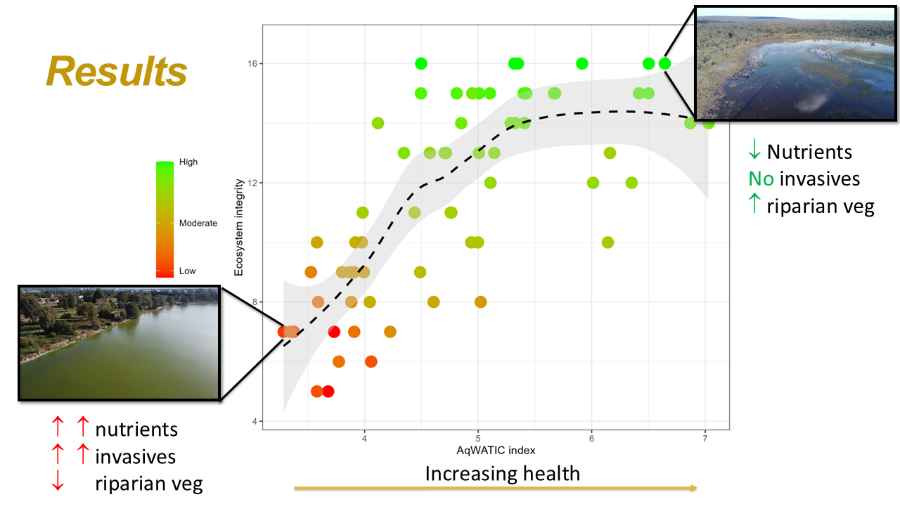
Figure 2: Preliminary results of the AqWAITC eDNA index score for each site (X axis) as compared against a semi-quantitative “benchmark” of expected “health” at each wetland (Y axis).